MIL-SPEC Survivability: Defense Stamped Electrical Terminals Engineering Guide
A MIL-DTL-38999 terminal that passes contact resistance testing can produce a 3-microsecond open circuit after 40 g shock pulses — invisible to a bench multimeter but long enough to ground an aircraft. The root cause is 15% normal force relaxation during thermal cycling.
In this guide, you will learn MIL-DTL contact resistance stability and MIL-STD-202 environmental test methods. You will also find salt fog corrosion thresholds and DFARS 252.246-7007 traceability protocols.
Read on for the full engineering guide.
Battlefield Environment Envelope
Thermal Gradient and Corrosion Synergy
Defense terminals encounter environmental conditions that commercial specifications never contemplate. A connector on a ground vehicle’s engine control unit cycles from -40°C during a winter deployment to 125°C inside the engine bay during operation, with the thermal transition occurring over 20 minutes from cold start to full load — a ramp rate of 8°C per minute that drives differential expansion between the terminal, the connector insert, and the mating pin at rates that static thermal cycling tests do not replicate.
Salt fog exposure adds a simultaneous chemical stressor: after 48 hours in a 5% NaCl atmosphere per MIL-STD-202 method 101, gold-plated contacts with any micro-porosity in the plating develop base metal corrosion that increases contact resistance and, critically, creates a rough surface that abrades the mating pin’s gold plating during the next mating cycle.
Altitude exposure introduces a dielectric stressor unique to aerospace and defense applications. At 50,000 feet, the reduced air pressure of 11.6 kPa lowers the dielectric breakdown voltage of the air gap between adjacent terminals by approximately 80% compared to sea level. A connector designed with 1.5 mm terminal spacing at sea level maintains adequate dielectric withstand at 500 V.
At altitude, the same spacing becomes marginal above 200 V. Defense terminals in unsealed connectors require a minimum 2.5 mm clearance for 500 V operation at altitude, driving larger connector shells and, consequently, larger terminal geometries that the stamping process must produce without introducing burrs that further reduce the effective clearance.
[Compliance Anchor]: Defense terminals must demonstrate contact resistance stability below 15 milliohms during shock testing per MIL-STD-202 method 213 condition F (40 g, 11 ms), measured with a high-speed data acquisition system capable of detecting discontinuities as short as 0.1 µs — standard milliohm meters averaging over 100 ms mask the transient events that cause avionics fault codes.
💡 Environmental Qualification Gap: Terminals qualified at ambient conditions can develop micro-porosity corrosion after 48 hours of salt fog — invisible at 5× but detectable at 10× magnification under MIL-STD-202 method 101. request a MIL-STD-202 test plan for your terminal design before committing to production tooling.
Military Qualification Framework
DFARS Traceability and DCMA Audit Readiness
Military connector qualification operates through a system of detail specifications and test method standards. MIL-DTL-38999 defines the performance requirements for circular connectors used in military aerospace applications, including contact resistance limits, mating durability, and environmental sealing.
The terminal itself is qualified as a component of the connector assembly — a terminal that passes contact resistance testing in isolation can still fail when assembled into the connector because the insert’s retention mechanism compresses the terminal body, altering the contact beam geometry by 0.02–0.05 mm. This shift changes the normal force at the separable interface, and the only valid qualification measurement captures this assembled-state performance.

DFARS 252.246-7007, the Defense Federal Acquisition Regulation Supplement on counterfeit electronic part detection and avoidance, imposes traceability requirements that flow down to the terminal supplier. Each production lot of terminals must be traceable to a specific raw material heat number, plating batch, and inspection record.
The traceability chain must survive a DCMA (Defense Contract Management Agency) audit that traces the terminal from the connector assembly back to the original copper alloy mill certificate. This requirement transforms terminal production from a commodity process into a documented manufacturing operation where every process parameter — stamping die stroke count, plating bath temperature, gold thickness measurement — is recorded and retrievable for the life of the defense program, which can span 20–30 years for platforms like the F-35 or Virginia-class submarine.
Beyond formal qualification, defense metal stamping suppliers must also comply with ITAR (International Traffic in Arms Regulations) if the terminal is a component of a defense article on the U.S. Munitions List. This restricts manufacturing to U.S. persons and imposes data handling requirements on all technical data, including terminal drawings, process specifications, and inspection reports — a compliance layer that commercial terminal suppliers rarely encounter.
[Compliance Anchor]: Defense terminal suppliers must maintain full material and process traceability per DFARS 252.246-7007, with the ability to retrieve lot-specific incoming material certs, plating bath logs, and inspection data within 48 hours of a DCMA audit request — a requirement that drives investment in lot-level digital documentation systems rather than paper travelers.
Defense Stamped Terminal Archetypes
MIL-DTL-38999 circular connectors, weapon system interconnects, and ground vehicle harness connectors impose distinct electrical, mechanical, and environmental demands that defense-grade stamped terminals must satisfy across the full MIL-STD-202 qualification sequence.
MIL-DTL-38999 Connector Contact Life
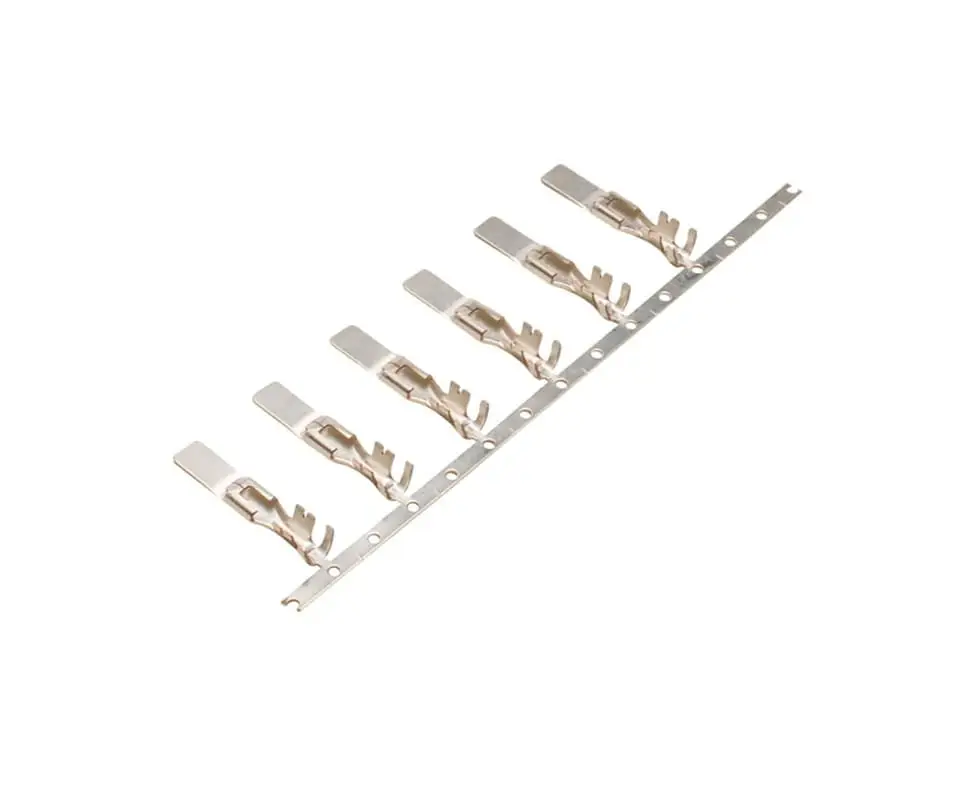
MIL-DTL-38999 circular connectors represent the highest-volume defense terminal application, with series I through IV covering environmental-resistant connectors for avionics, ground vehicles, and shipboard systems. The stamped socket contact inside a size 22D cavity must accept a 0.76 mm diameter pin while maintaining 10–50 grams of insertion force and a contact resistance below 5 milliohms.
The contact beam geometry — typically a formed leaf-spring design in beryllium copper C17200 — must retain this normal force after 500 mating cycles and 100 thermal shock cycles from -65°C to +175°C. The extreme temperature range eliminates phosphor bronze as a viable material: its stress relaxation rate at 175°C is approximately 3× that of beryllium copper, producing a 30–40% normal force loss after 1,000 hours at temperature.
Weapon System Shock and Chemical Resistance
Weapon system interconnects — missile launch rails, gun fire control, radar processors — introduce a pyrotechnic shock requirement absent from commercial specifications. When a missile launches, the connector experiences acceleration pulses exceeding 100 g with rise times under 0.5 milliseconds. The terminal’s mass — typically 0.05–0.10 grams for a size 22 contact — experiences a force of 0.05–0.10 N during this transient, which the contact beam’s normal force must overcome to prevent a momentary separation.
A terminal with 0.5 N normal force provides a 5:1 safety margin, but only if that force has not degraded from environmental exposure. This demands verification of normal force after the full qualification test sequence, not only on as-manufactured samples.
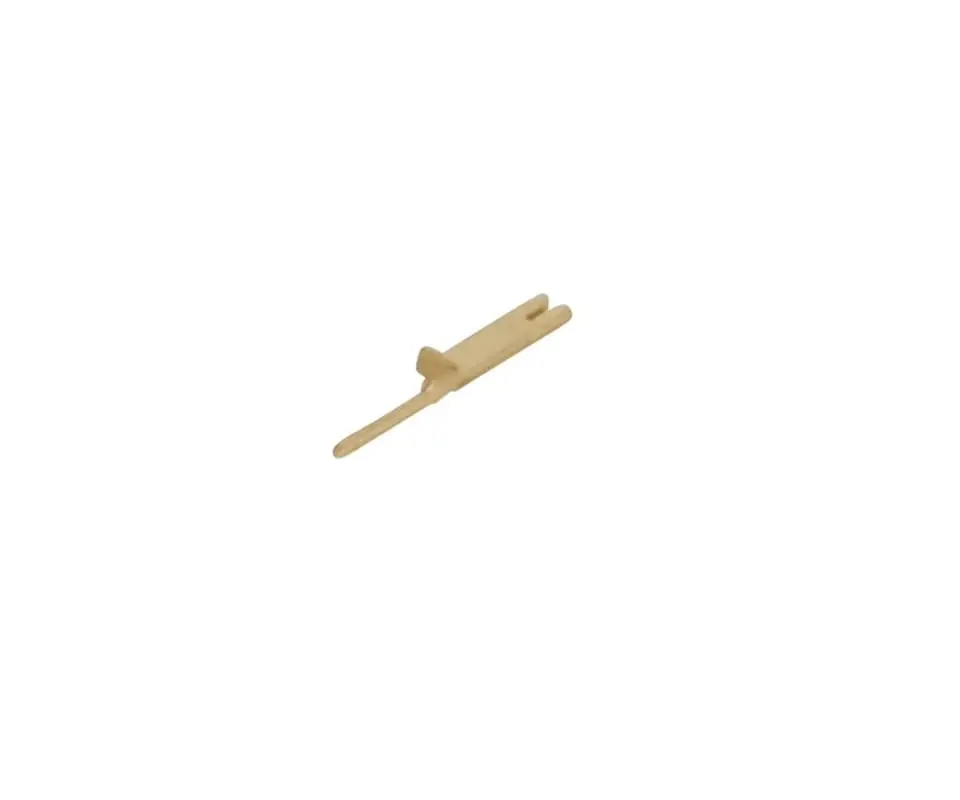
Ground vehicle harness connectors operate at the intersection of high vibration and chemical exposure. The connector on a transmission-mounted sensor sees continuous 10–2,000 Hz vibration from the powertrain combined with exposure to diesel fuel, hydraulic fluid, and de-icing chemicals. The terminal’s gold plating must resist chemical attack from these fluids — defense industry specifications often add a fluid resistance test per MIL-STD-202 method 215 to the qualification sequence, requiring terminals to survive 24-hour immersion in each specified fluid without plating delamination or contact resistance drift exceeding 5 milliohms.
[Compliance Anchor]: Beryllium copper terminal contacts for MIL-DTL-38999 connectors must demonstrate normal force retention above 0.3 N after the full qualification sequence (thermal shock, vibration, shock, salt fog, mating durability), measured with a calibrated force gauge on contacts removed from production-representative connector assemblies.
💡 Contact Design for Your Platform: The terminal’s normal force must account for both environmental degradation and platform-specific shock spectra — generic MIL-DTL limits may not capture your system’s pyrotechnic shock profile at 100 g with sub-millisecond rise times. submit your connector specification for a terminal recommendation validated against your qualification test sequence.
Counterfeit Prevention & Lot Control
AS9100 Inspection Data Packaging
The defense supply chain’s vulnerability to counterfeit components extends to stamped terminals. A terminal lot sourced from an unauthorized distributor may carry falsified material certs, use a lower-grade alloy, or apply a sub-specification plating thickness that passes a cursory incoming inspection but fails after environmental exposure.
Kravzik’s defense terminal production maintains a closed supply chain: copper alloy strip arrives directly from the mill with chemical composition and mechanical property certs, each coil identified by a unique heat number that follows the material through stamping, heat treatment, plating, and inspection. No material enters the production stream without a verifiable mill certificate, and no finished terminal lot ships without a certificate of conformance that traces back to the original heat number.
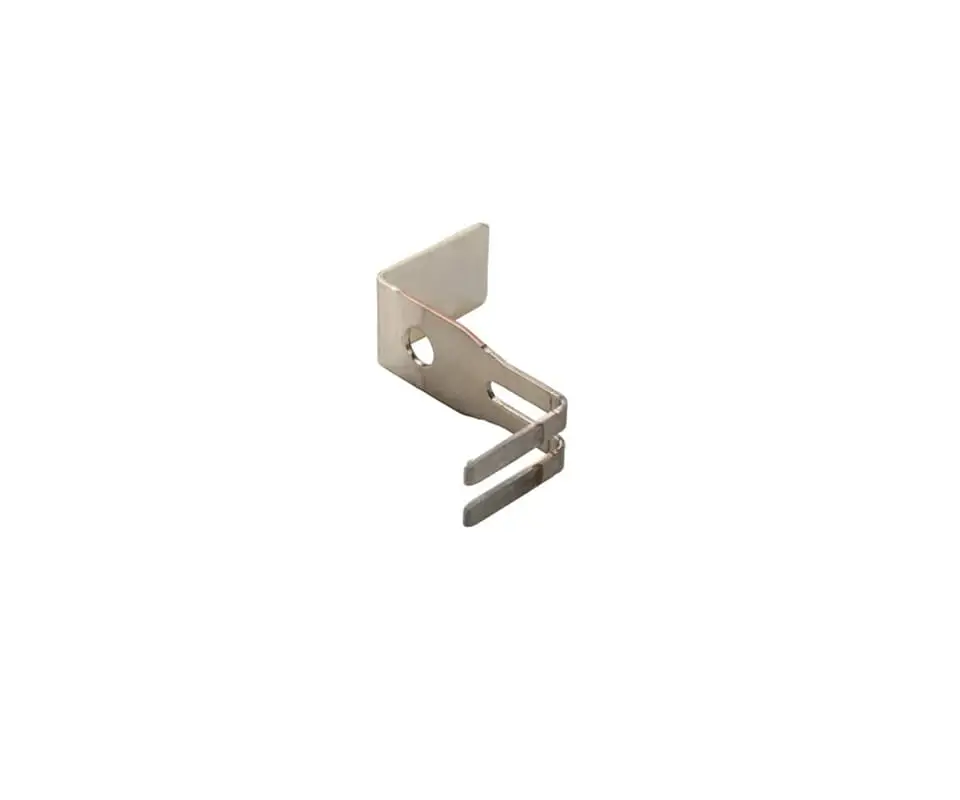
Lot control extends to the inspection data package. Each reel of defense terminals ships with gold plating thickness XRF reports measured at the contact zone, normal force measurements on a statistical sample per ANSI/ASQ Z1.4, and contact resistance data collected on production connector assemblies.
This data package satisfies the objective quality evidence requirements of AS9100 clause 8.5.1, enabling the connector manufacturer to incorporate the terminal lot’s inspection data directly into their device history record. High-speed progressive die stamping with in-die vision inspection adds a real-time quality layer: every terminal is imaged at 3–5 stations within the die to verify critical geometry, burr height, and plating coverage before it reaches the reel.
[Compliance Anchor]: Defense terminal suppliers must provide objective quality evidence per AS9100 clause 8.5.1 for each production lot, including raw material certifications, plating thickness data, and contact resistance measurements — with all records maintained for the life of the defense program plus 10 years per DFARS 252.246-7007.
Compliance Pass
Terminals passing production testing can fail normal force retention after the full MIL-STD-202 qualification sequence, triggering source inspection nonconformance. Kravzik stamps defense-grade terminals with full lot traceability from mill heat number to finished reel, shipping every lot with MIL-STD-202 test results structured for your AS9100 system.
Send us your contact specifications for a MIL-SPEC qualification data package, including full material traceability and shock-vibration test results.
Related Engineering Resources
- Beryllium copper C17200 spring properties and thermal stress relaxation data in copper alloy material property reference
- Gold plating thickness and porosity standards for MIL-SPEC connector contacts in gold and silver plating process capabilities
- Lot-level quality management and traceability systems for defense supply chains in quality management system documentation